
Impara con carte reali
Tre regole Riftbound in gioco
Questi esempi accoppiano la guida corrente con il testo delle carte dal snapshot ufficiale verificato degli errata. Leggi il testo della carta esattamente, poi segui la sezione di regole collegata per la sequenza completa.
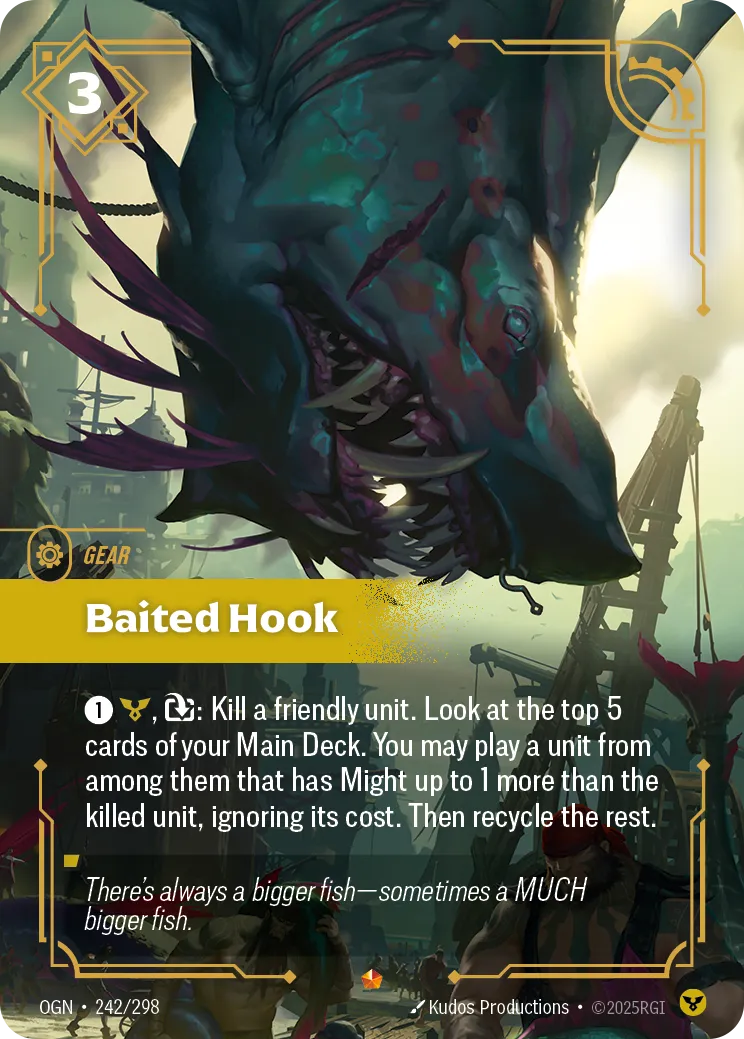
Pronto e esaurito · Baited Hook
Un equipaggiamento pronto può pagare un costo di esaurimento
Il Gear entra in gioco pronto. L'abilità ufficiale corrente di Baited Hook include un costo di esaurimento, quindi può usare quello stato pronto una volta ogni costo elencato e scelta è legale.
Testo ufficiale attuale della carta
1 energy[C], exhaust: Kill a friendly unit. Look at the top 5 cards of your Main Deck. You may banish a unit from among them that has Might up to 1 more than the killed unit and play it, ignoring its cost. Then recycle the rest.
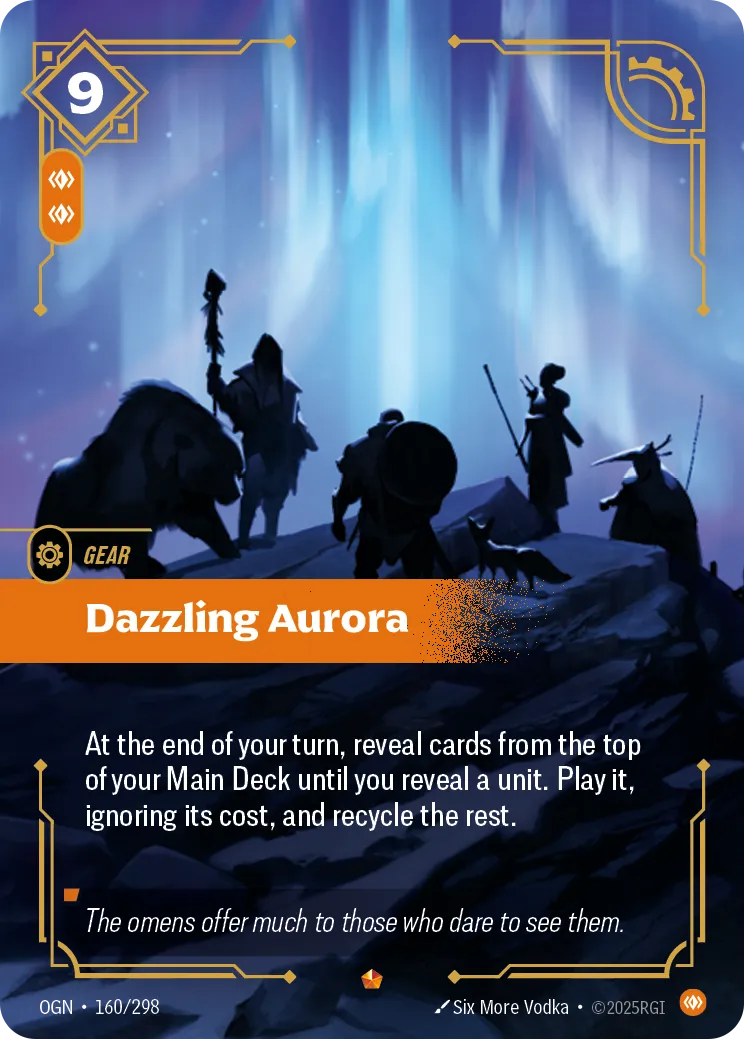
Fase di conclusione · Dazzling Aurora
Il testo di fine turno ha una finestra specifica
Le abilità «Alla fine del tuo turno» si attivano nella Fase di Fine. Dazzling Aurora segue quindi il suo testo ufficiale attuale in ordine, inclusa l'istruzione corretta per il bandimento.
Testo ufficiale attuale della carta
At the end of your turn, reveal cards from the top of your Main Deck until you reveal a unit and banish it. Play it, ignoring its cost, and recycle the rest.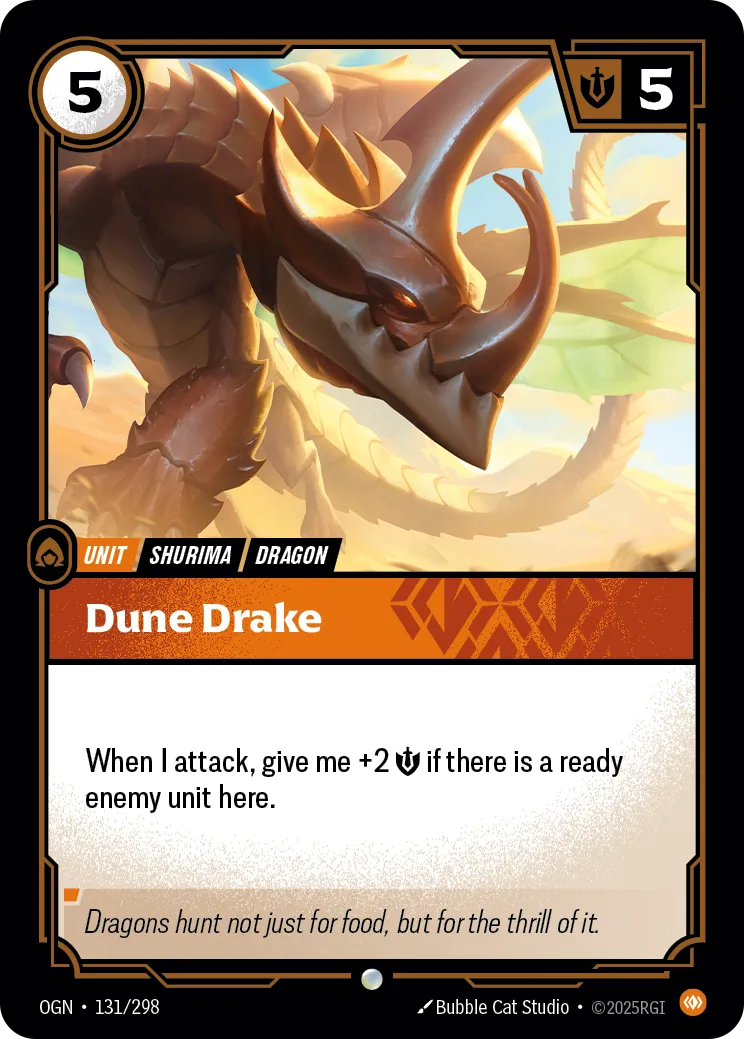
Ruoli in combattimento · Dune Drake
Il movimento decide chi attacca
L'attaccante è il giocatore le cui unità si sono mosse nel campo di battaglia e lo hanno conteso, non automaticamente il giocatore del turno. Quel ruolo è ciò che fa applicare il testo di Dune Drake "Quando attacco".
Testo ufficiale attuale della carta
When I attack, give me +2 might this turn if there is a ready enemy unit here.Provenienza del testo della carta: snapshot dell'errata ufficiale 2026-07-23, verificato 2026-09-07.
The goal
Riftbound is a battle for territory: move units to battlefields, take them, and keep them. Battlefields you take and hold turn into points — first to 8 wins.
What the full rules say
CR 001–056, 194–196
- "Card" in card text means Main Deck card only. Runes, legends, and battlefields are not "cards" to card effects.
- When executing card text, do as much as you can and ignore impossible instructions. If everything is impossible, the card still resolves — nothing happens.
- You win at a cleanup if your points ≥ Victory Score AND you have strictly more points than every other player. You also win if an effect says you win, or if you are the last player standing.
- Points can never go below 0, and losing points at 0 does nothing.
Building a deck
Four pieces: a Champion Legend, a 40+ card Main Deck, exactly 12 runes, and 3 battlefields.
| Piece | Requirement |
|---|---|
| Champion Legend | Exactly 1. Its domains are your Domain Identity — every card in your deck must fit them. |
| Main Deck | 40 cards minimum: units, gear, and spells, including your Chosen Champion. Up to 3 copies of any one name. |
| Chosen Champion | A champion unit whose champion tag matches your Legend's tag. It starts the game in its own zone, ready to play. |
| Rune Deck | Exactly 12 rune cards in your Domain Identity. |
| Battlefields | 3 in your deck (standard modes) — how many reach the table depends on the mode. No duplicate battlefield names. |
| Signature cards | At most 3 total across the whole deck, all bearing your Legend's champion tag. |
What the full rules say
CR 101–103, 133
- A card's full name is "Short Name, Subtitle" — Yasuo - Remorseful and Yasuo - Windrider are different names, so 3 copies of each is legal.
- The Chosen Champion counts toward its name's 3-copy limit: the chosen copy plus up to 2 more in the Main Deck.
- The signature limit of 3 is a sum across all signature cards of any type, not 3 per name. Unique cards are further limited to 1 copy by their own keyword.
- Cards an effect adds to your deck ignoring Domain Identity count as in-identity.
Starting a game
Set the board, draw 4, mulligan up to 2, and adjust for turn order.
- 1
Set the board
Your Legend goes to the Legend Zone and your Chosen Champion to the Champion Zone, both face up. Battlefields for the mode are placed between the players. Shuffle the Main Deck and Rune Deck separately. - 2
Turn order
Determine the first player randomly. Play proceeds clockwise from them. - 3
Draw 4
Each player draws a starting hand of 4 cards. - 4
Mulligan
In turn order, each player may set aside up to 2 cards, draw that many, then recycle the set-aside cards to the bottom of their deck. - 5
Balance the start
In a 1v1, the player going second channels 1 extra rune during their first Channel Phase. In 3+ player modes, the first player skips their first draw and the last player channels the extra rune instead.
The board
Two kinds of places matter: your Base and the battlefields. Everything else is a supporting zone.
- Base — your permanents and runes start and retreat here. Enemy spells can still reach it, but combat never happens here.
- Battlefields — shared locations anyone can move to. Any number of units can occupy one. Control of these is the whole game.
- Legend Zone — your Legend sits here all game and never leaves.
- Champion Zone — your Chosen Champion starts here and is played from here like a card from hand. It can only return here if the zone is empty.
- Hand, Main Deck, Rune Deck — hand contents are private (the count is public); deck order is secret.
- Trash — your discard pile: killed permanents, resolved spells, discarded cards. Public.
- Banishment — the harder-to-return removal pile. Public.
- Each battlefield also has a one-card facedown zone, used by Hidden — only while you control that battlefield.
Card types
Units fight, gear supports, spells resolve once, runes pay for everything.
| Type | What it does |
|---|---|
| Unit | Your armies. Has might Might — its strength in combat. Played to your Base or a battlefield you control, and enters exhausted. Moves between locations, fights, dies to the Trash. |
| Champion | A supertype of unit tied to a Legend by its champion tag. Plays like any unit; your Chosen Champion also plays from its own zone. |
| Gear | Equipment and tools. Played to your Base and enters ready. Equipment gear attaches to units via Equip and adds its Might bonus and abilities to them. |
| Spell | A one-shot effect. Resolves top to bottom, then goes to the Trash. Timing depends on its keywords — see Playing cards. |
| Rune | Your resources. Channeled from the Rune Deck, not played. Runes stay on the board but are not permanents — and not "cards" to card effects. |
| Battlefield | The locations you fight over. Never played, killed, or moved; set up before the game. Many carry abilities for their controller. |
| Legend | Your commander in the Legend Zone. Never played or killed; usually carries an ability you can use all game. |
What the full rules say
CR 135, 141–159, 184–188
- Cost symbols: the numeral is Energy; the vertical domain symbols under it are Power. exhaust means "exhaust this". might is Might.
- A card that is somehow two types at once follows both rule sets — a unit-gear dies to "kill all units" AND "kill all gear", and still enters exhausted like a unit.
- Tokens follow all the rules of their type but are not cards, have no cost and no domain, and cease to exist if they ever leave the board (except onto the chain).
- A card attached to another card turns its printed rules text off; its effect text and Might bonus apply to the card it is attached to instead.
Runes, energy & power
Costs come in two currencies: Energy (the number) and Power (the domain symbols). Your runes make both.
What the full rules say
CR 161–169, 429–430
- Add abilities resolve immediately, without passing priority — nobody can respond to you making resources.
- A recycled rune returns to the Rune Deck, never the Main Deck.
- Some Power is Universal — it pays costs of any domain. A domain-cost symbol on a multi-domain card is payable with any one of that card's domains.
- If your Rune Deck has fewer than 2 runes at your Channel Phase, channel as many as you can — running out of runes never burns you out.
The turn
Six phases, always in this order. Scoring happens at the START of your turn — you hold battlefields through everyone else's turns to get paid.
- 1
Awaken
Ready everything you control — units, gear, runes, your Legend. Everything that was exhausted stands back up. - 2
Beginning
Start-of-turn effects happen, Temporary permanents die, and then you score 1 point for every battlefield you control (a Hold). This is where patience pays out. - 3
Channel
Channel 2 runes from your Rune Deck. They enter ready. - 4
Draw
Draw 1 card. If your Main Deck is empty you Burn Out first — an opponent of your choice gains a point, your trash reshuffles into a new deck — and then you still draw. - 5
Main
First, every player's Rune Pool empties. Then do things in any order: play cards, move units, activate abilities, start fights. Combats and showdowns happen inside this phase. - 6
Ending
End-of-turn effects trigger, then everything winds down: all units heal fully, "this turn" effects expire, stuns wear off, and every rune pool empties. The next player becomes the turn player.
Playing cards & reacting
By default you act only on your own turn. [Action] and [Reaction] are the two permissions that break that rule.
| The moment | Who can play what |
|---|---|
| Your Main Phase, nothing happening | You can play anything — this is the only time normal cards without timing keywords can be played. |
| A showdown or combat | Only cards and abilities with Action or Reaction — this is where combat tricks live. |
| Something is on the chain | Only Reaction — the fastest speed, playable even on other players' turns in response to nearly anything. |
What the full rules say
CR 309–359, 425
- Playing a card: put it on the chain → make all choices and targets → total the cost → pay → check legality. If any check fails, everything is undone and the play never happened.
- Targets lock when the card finishes being played. Targets that later leave the board are simply skipped at resolution — the rest of the card still resolves.
- Rune and other Add abilities resolve instantly without a response window, and Reaction Add abilities may be activated in the middle of paying a cost.
- Activated abilities default to your own turn, chain empty, no showdown — unless the ability itself carries Action or Reaction.
- Priority: within a showdown, whoever holds Focus acts; passing priority on a chain does not pass Focus.
Moving & taking battlefields
Exhaust a unit to move it between your Base and a battlefield. Arriving where you're not welcome starts a showdown.
What the full rules say
CR 144–147, 445–458
- A battlefield with units from 2 other players (or an ongoing combat between 2 other players) is an invalid destination for your units, by any means.
- A forced move to an invalid destination becomes a Recall — the unit returns to Base. Recalls are not moves: they trigger nothing and cannot be blocked, and damage and statuses stay on the unit.
- Whoever moved in (applied the contested status) acts first in the resulting showdown.
- If several showdowns or combats are queued up, the turn player picks the order they happen.
Combat
Combat happens when two players' units share a battlefield. It is always exactly two players, and all damage lands at once.
- 1
Staging
Units of two opposing players stand at one battlefield. The attacker is whoever moved in — the player whose arrival contested the battlefield — not necessarily the turn player. The other player defends. - 2
Showdown
Attack and defend triggers fire, then players trade Action and Reaction plays — pumps, removal, tricks. The attacker acts first. This is the only window to affect the fight; once it closes, the dice are cast. - 3
Damage
Each side sums its units' might Might. The attacker assigns damage equal to their total across the defender's units, then the defender does the same back. Assignment must fill one unit to lethal before moving to the next — Tank units first, Backline units last. Then all damage lands simultaneously. - 4
Resolution
Units with lethal damage die together — mutual destruction is normal. Deathknell triggers fire. Then every surviving unit heals to full. If both sides still have units standing, the attackers retreat to Base — attacking into a wall you can't clear bounces you home. A lone survivor's side takes control of the battlefield: a Conquer, worth a point.
What the full rules say
CR 459–466
- Lethal = assigned damage ≥ the unit's Might, counting damage already marked. You cannot over-assign beyond minimum lethal except to the last unit.
- Tank: all Tank units must have lethal assigned before any non-Tank unit of the same controller. Backline is the mirror — last. A unit with both goes first or last at the assigner's choice, never the middle.
- Units that cannot take damage at all are exempt from mandatory assignment; units that merely prevent damage are not — prevention raises the amount needed for lethal.
- If the combat ends with no result and both sides still present, a new showdown and combat stage at the same battlefield.
- Winning combat as the defender also establishes control — the defender can be the one who Conquers.
Scoring & winning
Conquer battlefields to score now; hold them to score every turn. The last point has a special rule.
- Conquer — you take control of a battlefield you haven't scored this turn: 1 point, immediately.
- Hold — at the start of your turn, each battlefield you still control: 1 point.
- Each battlefield pays each player at most once per turn, by either route.
- Battlefields' own "Conquer" and "Hold" abilities fire when you score them — at most once per turn too.
- Some cards grant points directly, and an opponent Burning Out hands you a point if they pick you.
What the full rules say
CR 467–476
- The restriction applies while at Victory Score − 1 or higher, and "scored every battlefield" counts both Conquers and Holds this turn.
- Burn Out points cannot be prevented or replaced after the first Burn Out in a sequence — an empty deck and empty trash spiral ends the game.
- Team modes: battlefields a teammate controlled during your Beginning Phase can't be scored by your team that turn.
Reading abilities
Four shapes of ability cover nearly every card.
| Shape | How to spot it | How it works |
|---|---|---|
| Passive | A statement of fact: "Friendly units here have +1 might." | Always on while the card is in play. Nothing to activate, nothing to respond to. |
| Activated | "Cost: effect" — often exhaust or energy in the cost. | Pay the cost, effect goes on the chain. Usable on your turn with the chain empty unless it says Action or Reaction. |
| Triggered | "When…", "At…", "The first time…" | Fires on its own when the condition happens, on anyone's turn, and goes on the chain — it can be responded to. |
| Replacement | "As…", "would…, instead…" | Rewrites an event before it happens. The replaced event never occurred — nothing triggers off it. |
What the full rules say
CR 360–399
- "You may" at the very start of a triggered ability: decide when it would go on the chain — declining removes it. "You may" later in the text: decide when it resolves.
- A cost written into a trigger's first instruction ("Recycle me to …") must be paid for the trigger to stay on the chain.
- When several triggers fire at once, each player orders their own; players do so in turn order starting with the turn player.
- Dependent keywords like Level and Empowered switch their ability on exactly while their condition holds, and off the moment it stops — Level even re-checks against a new controller's XP.
Damage, statuses & counters
What sticks to a unit, what it does, and when it goes away.
| Marker | Effect | Goes away |
|---|---|---|
| Damage | Dies in a cleanup once damage ≥ might Might. Damage alone does nothing until then. | Heals fully after every combat and at the end of every turn. |
| Buff | +1 might. One per unit, ever — a second buff is simply not placed. Some effects spend buffs as a cost. | When the unit leaves play. Champions don't keep buffs in the Champion Zone. |
| Stunned | Contributes 0 might to combat damage — but still needs its full Might assigned to die. | End-of-turn cleanup. |
| Empowered | Switches on the unit's Empowered ability. | Doesn't wear off on its own; a card must remove it. |
| Facedown (Hidden) | Waits unseen at a battlefield you control; from your next turn it can be played there for free, with Reaction. | Removed if you lose control of the battlefield. |
| XP | A player resource — spent by some cards, and gates Level abilities. Gained mostly via Hunt and card effects. | Never expires; no cap. |
Modes of play
Same game, different table shapes. Standard 1v1 is the Duel.
| Mode | Players | Victory Score | Battlefields in play | First-turn balance |
|---|---|---|---|---|
| Duel (1v1) | 2 | 8 | 2 — each player brings 3, one is picked randomly | Second player channels +1 rune on turn 1 |
| Match (1v1, best of 3) | 2 | 8 | 2 — each player brings 3 and chooses one; battlefields from a won game are retired for the match | Second player channels +1 rune on turn 1 |
| Skirmish (FFA3) | 3 | 8 | 3 — one random from each player | First player skips their first draw; last player channels +1 rune |
| War (FFA4) | 4 | 8 | 3 — the first player's battlefields are removed entirely; one random from each other player | First player skips their first draw; last player channels +1 rune |
| Magma Chamber (2v2) | 4 | 11 (team) | 3 — first player's battlefields removed; one random from each other player | First player skips their first draw; last player channels +1 rune |
- Turn order alternates teams, and teammates share one point total — you win and lose together (a concession loses for the whole team).
- "Friendly" includes your teammate's units — but control is not shared: you can't move their units or hide cards at their battlefields.
- You may act on your teammate's turn only when they invite you using their own priority.
- Battlefields your teammate controlled during the Beginning Phase of your turn can't be scored by your team that turn — no retreat-and-reconquer relay plays.
- Teammates can't use the same Champion Legend or the same battlefields, and hands stay private — though you may choose to show yours.
Domande frequenti
Risposte dirette alle domande sulle regole di Riftbound che interrompono più spesso una prima partita, con i riferimenti RUP4 attuali per ogni decisione.
- What is the difference between conquering and holding a battlefield?
- You conquer when you gain control of a battlefield you have not already scored that turn. You hold when you maintain control of a battlefield during your Beginning Phase and have not already scored it that turn. Either event scores that battlefield, can grant up to 1 point, and triggers its matching Conquer or Hold abilities.
- Regole 469.1., 469.2., 471.1., 471.2.
- Why did conquering a battlefield not give me my eighth point?
- The final point from Conquer has an extra requirement: you must have scored every battlefield that turn. If you have not, you draw 1 instead. Points from sources other than Conquer do not use this restriction. Reaching 8 also does not end the game until a cleanup finds you at or above the Victory Score and strictly ahead of every opponent.
- Regole 471.1.a.1., 471.1.b.1., 194.2., 323.1.
- What is a standard move, and where can a unit go?
- During your Main Phase, outside a Showdown, Combat, or Closed State, you may exhaust a ready unit to make its standard move. A normal standard move goes from your base to a battlefield or from a battlefield back to your base.
- Regole 144.1., 144.2., 144.4.a., 144.4.b.
- Does a unit exhaust when a spell or ability moves it?
- Not unless that spell or ability says so. Exhausting is the cost of the unit’s standard move; it is not an automatic result of every Move effect.
- Regole 144.2., 420.2.b., 420.3.
- Can I move several units to the same battlefield together?
- Yes. You may perform multiple units’ standard moves simultaneously as one game action. They must share the same destination, but they may start in different locations, and all of their exhaust costs are paid simultaneously.
- Regole 144.3., 144.3.a., 144.3.b., 144.3.c.
- Does Ganking give a unit an extra move?
- No. Ganking expands the destinations of that unit’s existing standard move so it may move from one battlefield to another. It does not create an additional move or remove the standard move’s exhaust cost.
- Regole 810.1.b., 810.1.c.3., 144.2.
- Can a unit move or use an exhaust ability on the turn it enters?
- Units normally enter exhausted, so they cannot pay an exhaust cost until they become ready. Accelerate lets you pay 1 Energy and 1 matching Power as an additional cost so the unit enters ready; a ready unit can act immediately when the normal timing rules allow it.
- Regole 178.1.a.1., 805.1.a., 805.6., 144.1.
- What happens if both sides survive combat or have the same total Might?
- Both players assign damage and all assigned combat damage is dealt simultaneously. During Combat Cleanup, lethal units die, surviving units heal, and attackers are recalled if defenders remain. If both players still have units there, combat has no result and another Showdown and Combat are staged.
- Regole 465.2.c., 465.2.d., 466.1.a.1., 466.1.a.2., 466.3.d.1.
- When does damage heal from units?
- All surviving units heal during Combat Cleanup and all units heal again during the Ending Phase cleanup. Lethal damage is checked before that healing step, so a unit with lethal damage dies instead of being saved by the automatic heal.
- Regole 323.4., 323.5., 466.1.a.1., 317.2.b.
- Does a unit die just because its Might becomes 0?
- No. Lethal damage must be a nonzero amount equal to or greater than the unit’s Might. A unit at 0 Might survives until it has at least 1 damage marked on it or another effect removes it.
- Regole 143.2.a.
- How do runes make Energy and Power, and can I recycle an exhausted rune?
- A basic rune has two separate Reaction abilities: exhaust it to add 1 Energy, or recycle it to add 1 Power of its domain. Recycling does not require the rune to be ready, so an exhausted rune may still be recycled. Unspent Energy and Power disappear at the end of the turn.
- Regole 164.2.a., 164.2.b., 164.2.b.1., 317.2.d.
- What is the difference between Action and Reaction?
- Action gives a card or ability permission to be used during Showdowns on any player’s turn. Reaction includes every Action permission and also permits use during Closed States while a chain exists. A Reaction does not need to answer a specific card, but you still need an appropriate priority window.
- Regole 806.1.b., 806.1.c., 813.1.b., 813.1.c.
- Can I play a card with Hidden on the same turn I hide it?
- No. You hide it facedown at a battlefield you control by paying 1 Power during an Open State on your turn. Beginning on the next turn, it gains Reaction and may be played while ignoring its base cost.
- Regole 811.1.b., 811.1.c.2., 811.6.
- Where can a card played from Hidden go or choose targets?
- A hidden permanent must be played to the battlefield where it was hidden. Targets chosen by a hidden spell or a hidden permanent’s play effect must normally be at that battlefield, and any unit that effect tells you to play must also be played there.
- Regole 811.1.d.1., 811.1.d.2., 811.1.d.3.
- What happens if a spell or ability loses a legal target before it resolves?
- Targets are chosen when the item is finalized on the chain. If a target is illegal when the item resolves, that target is unaffected and instructions linked to it are ignored. Other independent instructions still happen when possible, and the card is still considered played even if every instruction ends up doing nothing.
- Regole 355.14.b., 359.3.e.1., 359.3.e.5., 359.3.e.10.
- Does my Chosen Champion return to the Champion Zone after leaving play?
- Not by normal means. After you play it, it goes wherever the effect or game rule sends it, usually the trash or your hand. Any Champion Unit with the same name as the card chosen for that slot counts as your Chosen Champion, and the chosen copy is included in the normal three-copy deck limit.
- Regole 108.3.c., 103.2.a.3., 103.2.b.1.
- What happens when I try to draw from an empty Main Deck?
- You Burn Out: complete as much of the draw as possible, recycle your trash into your Main Deck, choose an opponent to gain 1 point, then finish the draw. If both deck and trash remain empty, repeated attempts can cause repeated Burn Outs.
- Regole 431.1.a., 431.2., 431.3.
- What exactly does Deflect protect against?
- Deflect adds a mandatory Power cost to opposing spells and abilities each time they target that object. It does not prevent the object from being affected by an instruction that does not target or choose it, and multiple Deflect values add together.
- Regole 809.1.c., 809.1.d., 809.2.
- How do Tank and Backline change combat damage assignment?
- Tank units must receive lethal combat damage before friendly non-Tank units can be assigned damage. Backline units must receive lethal damage after friendly non-Backline units. If one unit has both and the requirements conflict, the assigning player chooses which one of those requirements to satisfy.
- Regole 815.1.b., 815.1.c.2., 826.3., 465.2.c.8.
- Who chooses the order when several abilities trigger at the same time?
- One player chooses the order of simultaneous triggers they control. If several players control triggers, the Turn Player orders theirs first, followed by each player in turn order. Because the newest chain item resolves first, triggers placed later will resolve earlier.
- Regole 383.3.d., 383.3.d.1., 340.1.